An Editorial
The Story of Point Piper
From a captain's folly to one of the most coveted addresses on earth.
Chapter One
The Rise and Fall of Captain Piper
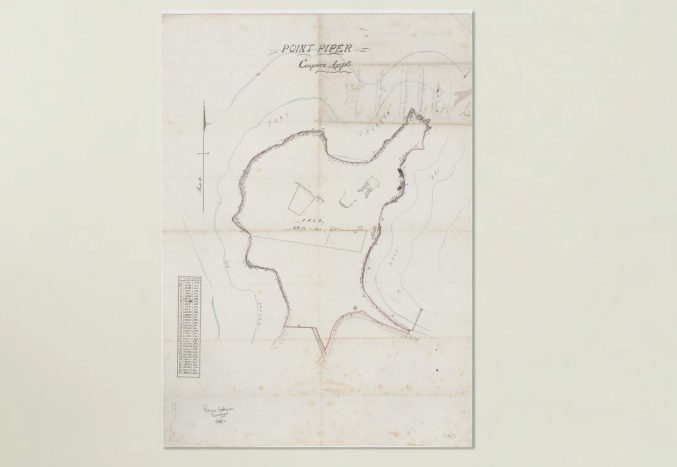
In 1816, Governor Macquarie granted a New South Wales Corps officer named Captain John Piper a peninsula of 190 acres jutting into Sydney Harbour. It would carry his name forever after. Piper had arrived with the Corps in 1792 and risen to captain, but his fortune was made in 1814 when he took the civil post of Naval Officer for Sydney Harbour, collecting the colony's customs duties — and keeping five percent of everything he gathered. At the peak, that commission ran to thousands of pounds a year, making him one of the wealthiest men in Sydney.
He spent accordingly. Between 1816 and 1822 he built Henrietta Villa — also called the Naval Pavilion — at the staggering cost of £10,000, widely considered the most elegant house in the colony. Piper threw lavish parties, kept his own band, and rowed to town in a barge crewed by uniformed oarsmen. Beyond Point Piper he amassed enormous holdings across Vaucluse, Woollahra, Rose Bay, Neutral Bay, Petersham, Bathurst and beyond.
The descent was swift. Piper proved careless in his customs duties, and when an enquiry uncovered a deficiency in his accounts, Governor Darling demanded the shortfall be made good. In 1826 he raised a mortgage of £20,000; by 1827 he had resigned the chairmanship of the Bank of New South Wales and been suspended as Naval Officer. Facing ruin, Piper rowed out into the harbour one evening intending to drown himself — and was pulled from the water and survived. He retreated to the country near Bathurst, where he died in 1851. The harbourside point still bears his name.
He kept his own band, and rowed to town in a barge crewed by uniformed oarsmen.
Chapter Two
The Convict Who Bought the Point
The man who absorbed Piper's empire was, improbably, a former convict. Daniel Cooper had been transported to New South Wales in 1816 for larceny, received an absolute pardon in 1821, and built a series of thriving ventures — shipping, milling, and the famous mercantile partnership of Cooper & Levey with fellow emancipist Solomon Levey.
As Piper's finances collapsed, Cooper and Levey acquired his estates, taking the Point Piper land between 1826 and 1827. Cooper moved into Piper's own Henrietta Villa, and by 1847 was sole owner of the lot. He returned to England in 1831 and died at Brighton in 1853.
Chapter Three
The Baronet of Woollahra
The estate passed to his nephew, also named Daniel Cooper, born in Lancashire in 1821 and brought to the colony as a child. The younger Cooper took control of the family business, entered politics, and became the first Speaker of the New South Wales Legislative Assembly — later created Baronet of Woollahra.
In 1856 he built the first Woollahra House at Point Piper, naming it for the Aboriginal word said to mean "place of deliberation." His son, William Charles Cooper, bought the 190-acre estate from his father in 1882 and in 1883 raised a second, grander Woollahra House on the site of Piper's old villa — a two-storey stone mansion crowned with a mansard tower.
He named the house for the word said to mean a place of deliberation.
Chapter Four
The Coal Miner's Palace
The last private owner of Woollahra House was, like the convict before him, a self-made man. Thomas Longworth was born in 1857, the son of a Newcastle coalminer, and as a boy he worked the pits alongside his father. The family opened their own small mine near Singleton in 1878, and from that seam Longworth built an industrial fortune.
Around the turn of the century he bought Woollahra House from the departed Cooper estate — a coal miner's son taking the keys to the grandest palace in the land. He lived there in considerable style, and had a steam yacht, the Cobar, built for the harbour at his door. When he died in 1927, his estate was valued at more than £305,000.
A coal miner's son took the keys to the grandest palace in the land, and kept a steam yacht at the door.
Chapter Five
The Subdivision
After Longworth's death the contents of Woollahra House were auctioned, and in 1929 the great mansion was pulled down for the last time. Its grounds were carved into the streets that survive today — Wunulla, Wyuna, and the avenue that still bears the Longworth name. The hand-drawn survey plans and auction posters from this era chart the transformation of one captain's extravagant folly into one of the most coveted addresses on earth.
Two fragments of the estate still stand. The old stables, converted long ago into apartments, remain on Longworth Avenue; and the gatekeeper's lodge, built in 1871, survives as the Rose Bay police station. The great house is gone — but its plans, and these two quiet buildings, are what remain.